Monday, December 31, 2012

Looking ahead to 2013 together

It's been too long, too much has happened... even I have struggled to stay in the loop.  So instead of a recap - a few quick comments on 2013 ahead.

I'm setting up a business.  Still in alpha: a mission-driven enterprise to realise the positive potential of changes in the ways we work.  Communities, networks, agility and collaboration... all that stuff I do.  But more than anything, providing support to those contributing to this vision.  I'm pretty excited about this one - nearly as excited as I am about what the experience will hold.

The first big project will be a book, also in alpha: Collaborative Communities 101.  To help potential agents of the future and develop collective literacy... by making the essentials accessible: the core that an agent needs in the emerging collaborative future.

I'd be grateful if you could kindly keep me accountable to my part in these - making sure they happen.  And also to my four focus areas - resolutions if you'd like:

  • be a good person - be genuine, kind and serve others
  • think big and lead - look at the bigger future, and be compelling in inviting others to join me cocreating it 
  • dedicate - stick with it and do it properly
  • work better, together - stand on others' shoulders and develop capacity collectively


Let's have a wonderful 2013 together.


www.jsbaxter.com.au
@JohnSBaxter

Saturday, December 8, 2012

'Social Business' - what's it all about?

This is my take on 'social business'.  It refers, in short, to businesses that are social in nature - that are a connected part of society.

I'm referring to Australian/UK usage here, so I'm not referring to social enterprise - businesses created for social purpose - which is the meaning of 'social business' in other places.

And yes, all businesses are inherently social.  Some people think this makes it a pretty empty phrase.  I disagree.

All businesses may be social, but they don't necessarily act like it.  The main factor defining 'social' is interconnection.  Most of the time, businesses construct elaborate, reinforced boundaries to separate them from the outside world.  Their interfaces are distinct, controlled channels like communications / marketing, or product<>money exchanges.  Businesses try to eliminate their 'social' nature, preferring to instead interact with markets, or individual customers.

Sound familiar?  Social businesses are networked businesses.  I may have written about them before.

I got thinking about this today reading the blog of @ChrisBrogan.  Chris is a pretty cool dude.  He knows his stuff (marketing, sales, service // business design), and he shares a lot of good content at www.ChrisBrogan.com.  He was also the #1 Diigo result for 'social business'.

His take on 'social business' is social media as a communications tool.  From a traditional business perspective, this is a fair stance.  But it is only the start of social.

Maximising the opportunities of social business goes beyond reviewing communications practices.  Don't just take my word for it (@Nilofer)!  Social business is about reimagining businesses' role in the social ecosystem.

The traditional role and purpose of a business is to create a product, sell it to people, and make as much profit as possible.  Simple.  But in reality, businesses have complicated sets of relationships, and a role in the ecosystem that can't be reduced to products + sales = profits.  Increasing interconnectivity accentuates these complications.

Businesses that recognise this complication are in a great position.

By shifting focus to the value they create in the ecosystem, businesses can better understand their future and financial sustainability.  Focusing on value also highlights opportunities for innovation that a narrow product-sales-profit focus might never illuminate.  Shifting perspective to value also opens business up to the opportunities of shared value.

Some businesses might be able to ignore this whole 'social' thing... those in stable markets that create value in a very straightforward way.  For now.  But the others will be left behind if they think that a Facebook and Twitter marketing strategy will keep them at the front of social business.


www.jsbaxter.com.au
@JohnSBaxter

Sunday, November 11, 2012

Community is Important


We've all experienced stale 'community' environments.  Workplaces rife with distrust.  Volunteer organisations with a few ardent leaders - and volunteers who arrive passionate and leave disengaged.  'Community' or 'networking' groups where everybody seems to have their own agenda.

These spaces either don't have underlying community, or are affected by major pathologies.  Nobody is looking after the health of the community.  More often than not, the community's champions are actively undermining it.

Community requires a web of healthy, synergistic relationships between community members.  Trust is built up through interactions.  People associate with the group, and care for one another.  And yes, this takes care and attention.

Organisations seem to get away without dedicating proper care to community.  Organisations dehumanise, forcing people into transaction-based behaviour systems.  This applies to staff as well as customers.  It works - up to a point.  The side effects are dissatisfaction, poor performance, and an expensive HR and Corporate Services maintenance bill.

Many organisations are held together, despite dysfunctions, by expensive band-aids.  They get away with neglecting community because they have the resources.  If you don't have the resources, you don't have a choice.  Initiatives that fail to appreciate this fail to survive.

Appreciating the importance of community is only the start.  Most of our methods for organisation were developed for large corporations.  Established ways to manage, make decisions, communicate and sell our products and our selves - command and control management, marketing, broadcast communications...  Community is completely below the radar of the organisational paradigm that created these methodologies.

Established methods don't foster community - they undermine it.  They incubate community pathologies and lead to stale, unhealthy environments.

Successful, sustainable initiatives need to be informed by principles and approaches that support community.

Now, I'm sorry if this disappoints - but I don't have The Answers, and these aren't clear or well refined like the tools of corporate management.  Neither for me, nor as far as I can tell, for any others.  Though there is a lot of really great work out there to start from.  (Google 'social business' for a start. Loving @Nilofer's work at the moment.)

As I work through content and synthesise the progress others have made I'll be sharing what emerges.  My last post, about the firestarter community maturity metaphor, is a start.

As I get my head around a few different pockets, I feel like I'm finally getting to a position of pragmatic knowledge.  It's exciting!  I look forward to testing, sharing and doing some meaningful work.

So, back to it!


www.jsbaxter.com.au
@JohnSBaxter

Thursday, November 8, 2012

Firestarter - community maturity metaphor


This is based on the concepts (like 'unfulfilled need' and 'ambition') and community framework from @alexknowshtml's Community Builder Masterclass.


Starting a community is like lighting a fire in the dark.

Initial stages - light the match

Wood is 'unfulfilled need' - burning wood releases energy in the fulfillment of the need.  Community is the coming together to address shared needs; creating a stable, vibrant, resilient fire that not only fulfills the common need, but also propogates the fire and supports more burning.

You only start a fire when you think you can find wood that will burn well enough.  You might not be able to see it clearly in the dark, before you start, but there's no use making a fire just because you want one - despite the fact that you've got no wood.  Similarly, you may feel twigs that you're pretty sure will catch, but finding your hearth wood is more difficult.  You won't know in advance exactly what core logs will sustain your fire.  But you should have a hunch that they're out there!

You can't start a fire by holding a match to hardwood anyway.  You need to find some kindling which will catch readily...

So in the early days, you need to spark the fire based on something you know will catch - your match might be a meetup event that you invite your friends to and put out the word to a couple of other community groups.  People don't jump straight in to something they haven't really felt out, so a 'safe', 'fun' event is a great place to start.  Get a couple of speakers as drawcards, some music and free stuff if you can.

This stage is all about the excitement, spark, and making important initial connections.  It will be quite hands on - but it doesn't mean you should do it in isolation. Ideally, you'll connect with the interests of at least one other.

Nurturing - fan the kindling

You can strike the match, and you can light some kindling... but chances are (unless it's really potent stuff) that you'll need to put a lot of your own hot air in to fanning the kindling in the early stages.  Kindling can die out even more quickly than it lights, so you need to be on top of it, continually fanning and prodding.  You'll probably have a few different sorts of kindling, some that will burn quickly and easily but won't last (your paper might be themed parties), some that takes a bit more effort, will last longer, but in isolation doesn't produce a very strong flame (your splinters and twigs might be discussion events)... you need to monitor and manage all of these, in an effort to get a solid, active flame going that will catch more substantial wood.  Don't dump a whole lot of fuel on the fire at once because it will snuff out what's there, and don't try catching solid logs too soon either because they just won't burn.  You need to build it up gradually, and if you have a few different sorts of kindling (which is always wise), you'll need to feel out what works best and how different things burn.

In this stage, you'll be an active champion and responsive organiser.  You'll be talking to people, connecting dots, organising, bringing things together...  but you also need to be very responsive to changes, and use this time as an opportunity to understand what interests are out there, and what will catch.    This phase will take a lot of your time and attention and be very fragile.

Grounding - identify the hearth logs

Burning kindling, sticks and smaller logs will give you the chance to test what sorts of things burn, and how they burn.  You'll develop a better sense of the sorts of wood that burn best, and with the light of the fire you'll be able to guage what sort of fuel supplies are available.  Use this testing and the new light to identify what wood will be the heart of your fire.  This wood will be your ambition.

This isn't really a separate phase in time, but it does need to happen between getting the fire started and moving on to burning solid logs.  This is your 'research', and the analysis of this research, turning it into something solid to work towards.  It's best to do this with a growing group who can help nurture the fire in future.

Rally - direct energy at the logs

The happily burning twigs are the activity of the active, but immature, emergent community.

Direct attention towards the logs, by placing the sticks and smaller bits of wood around the logs.  Split bits of hard wood off that will catch and help spread fire to bigger logs.  If you've built the fire up properly, you won't need to pay much attention to the smaller stuff - you may need to dump more twigs on, but this should be easy enough if there is fuel nearby and it won't take too much of your own effort.  But don't waste time admiring the glow of the small stuff!  Sooner or later you WILL run out of readily available fuel, the fire will wane and you'll be back at point zero.  You need to take advantage of the fire you have to move on to the more substantial and sustainable wood.  This will catch slowly around the edges at first, it may seem like it will never really burn, but with some persistence you'll find the fire around it has done its work and the main log will catch.

Use campfire stories to illustrate the unfulfilled need that can form the heart of your community, its long-term fuel, and the potential for the community to address that need itself.  Let the community activity fan out in different directions and burn strongly, to keep things going without too much fiddling, and to keep the heat up, but also direct attention and experiences back towards the centre - towards the core ambition and the future of addressing this.  Splinters of hardwood can make good campfire stories of little ways that we can fulfill the ambition.  But we also need to think about the future, and develop a shared sense of burning that future.

This phase is primarily about leadership.  You shouldn't need to be actively organising or championing activity at this stage - perhaps just stepping in to prompt, guide or help sometimes - because if the community activity is built on a solid mix of fuel and a suitable volume of activity then other community members will look after this on their own.  This leaves your attention to foster discuss and visioning of the community's future.

If you're still doing most of the organising at this stage, you need to find ways to better structure the twigs and sticks for mutually supporting community activity, and also find ways to step back and let the fire take on its own shape.  If you're still very hands on, it is probably a sign that you've been too controlling and haven't fostered the emergence of natural community activity.

Structuring - build up the logs

Getting the hardwood burning is probably the hardest part.  Once it's caught it burns quite a strong, long lasting flame.  For this to form a resilient community fire, the wood just needs to be built into some sort of a structure.  This might be little more than identifying a few suitable logs (initiatives, projects or programs for community activity in pursuit of the ambition) and throwing them together.  Some fires might demand a bit more thought into how these logs are structured - particularly if there is a chill wind blowing or rain.

This phase is about creating resilient frameworks and structures, for the community activity of the hearth to be self-supporting, reinforcing, and vibrant.  This means establishing imperatives, policies and organisational systems.  While these can be initiated earlier to guide community activity, they can stifle the fire without the solid flames of burning hardwood.

In this phase, it should be possible to step back from championing and leading the vision, which can be adopted and carried on by the maturing community.  The main firestarters' focus will be on internal matters of systems etc, and you're most likely to be working with the community's core team than with the broader community.  There should be little need to put your own hot air into the fire, though you need to keep your eyes open to make sure the fire is progressing healthily.

Also bear in mind that this phase doesn't mean it's time to start directing and managing - structures created must be responsive to community energy and intention.  There's no use building a beautiful monolithic pyre on top of a log, only to discover later on that the end sticking out the side of the pyre is where all the action is at, and it's starting to whither and die out due to its exposure.

Pre-maturity - participate

If the community has grown through all the past phases, then by this stage it will be active, energetic, resilient and long lasting.  There will be little need to actively interfere with it.  The main attention it needs is oversight and a bit of maintenance to keep it on track.  Things to watch out for particularly are adverse external conditions, and the emergence of internal pathologies due to structural issues.

This stage is happy because it frees you to actually participate freely in the community, enjoy its warmth, in a way that probably hasn't been possible earlier on.  In fact, active participation is the best way to keep on top of emerging issues.  It's just important not to get complacent.

Post-maturity - steward

The hearth wood of a fire will eventually break down, structures will break down, and while the fire will remain active and fairly stable for some time, it will lose some of its energy and intensity as fuel is spent.  The flame is still strong - in fact, the smouldering coals of a mature fire can be the most reliable and efficient source of energy.  But volume decreases, and as structures collapse this has the potential to both release new energy, or smother more fragile activity.

Communities in this stage will need a little more attention, but it's probably time for hard questions.  The first one will always be about the underlying ambition - with this no longer a stong imperative, what happens now?  Communities can last, and often get very stale, on the basis of momentum, long past relevance to their purpose.  This means careful selection of any new fuel, and also hard questions about what to let go of, to keep the community going with good vibrancy but in a new, different - likely smaller - role.

Rebirth?

Where to from here?  There is no set path.
Letting go and walking away is one good option.
Rebirth is another.  This might mean finding new sources of fuel to dump on the fire, to hope it can be reborn again in a new form, rising like a phoenix from the ashes.  Or it might mean taking the coals or flames from this fire to start another elsewhere.

In any case, it's best to be aware of the dwindling fire, and to be prepared sooner rather than later.


www.jsbaxter.com.au
@JohnSBaxter

Tuesday, October 30, 2012

The networked future


This is the first cut intro to the vision I'm writing up - which seems to be turning into a manifesto...  From here I need to go through references and links, as a first stage of refinement to create something of higher quality.  There are some chronic gaps - like what a 'network' is.  Let it be for now.... but let me know what you think of the start!


We're moving into an increasingly networked future.

Networks are becoming increasingly prevalent - as organisations, institutions, aspects of our day-to-day lives, ways of coming together, and ways to make things happen.

In the past, it was expensive and difficult to coordinate the activity of multiple agents.  Hierarchical bureaucracy was required to coordinate activity as organisations scaled up in size.  But changes in communications technologies mean bureaucracy is less and less necessary as an organisation method - and increasingly expensive and ineffective in getting things done, in comparison to network-based methods.

It's not that other structures won't be around - or have an appropriate, rightful place in the social ecosystem.  But networks will be more important than they are today. They will be much more important and prevalent than we can effectively take advantage of, with our current collective capacity to work in networked ways.

Effective agents of the future will need new, networked modes of operation.  We need to build on current ways of working that run counter to network-agency, and we need to develop our networked methods that are unsophisticated and underdone.  These will depend upon new mindsets and philosophies as well - a paradigm shift in how we think about 'organisation'.  Current mindsets undermine effective action by blinding us to the role of networks, and erecting barriers to using them effectively.

Networked modes of operation are not about 'keeping up' - yet.  These methods present new opportunities to tackle the sticky and wicked problems that are the thorns in the sides of today's paradigm.


www.jsbaxter.com.au
@JohnSBaxter

Sunday, September 23, 2012

Enough is enough!; collaboration; Pareto

I am gradually learning when enough is enough.  I hadn't had much experience working in open collaborative ways like I am now... I've had a long way to come - and still a long way to go.  This post might be a bit abstract, and it might seem convoluted.  But the number of times I'm surprised at people's impractical approach to work and time tells me it's worth writing.

By 'enough is enough', I don't mean that your widget is sufficiently polished to be placed on the mantle - that you should stop and ship.  I mean that you have done enough to need to change tack - and in particular, to seek advice, feedback, or collaborative input.


There's a fallacy in our philosophy of work.  We assume that things we're doing take a certain number of hours, and that we need to efficiently stack these up to get them done, and thus be successful, useful, or win. Simple, right?  Work is a set of ingredients (otherwise known as tasks) that you churn through as efficiently as possible?  I know we all know that's not quite right - but too many times when I talk to people about 'work', it's obvious that that's the philosophy they bring to it.  As obvious as it can be to me when I hear it, I think I'm not much different.


Look at the way we approach time billing.  We don't just use it - we fetishise it.  If your work is complicated, six minute increments of time spent aren't a good measure of how you've created value - the real value of why you're working in the first place.  It's crazy!  But so many places seem to think the few minutes around the edges are worth worrying about.


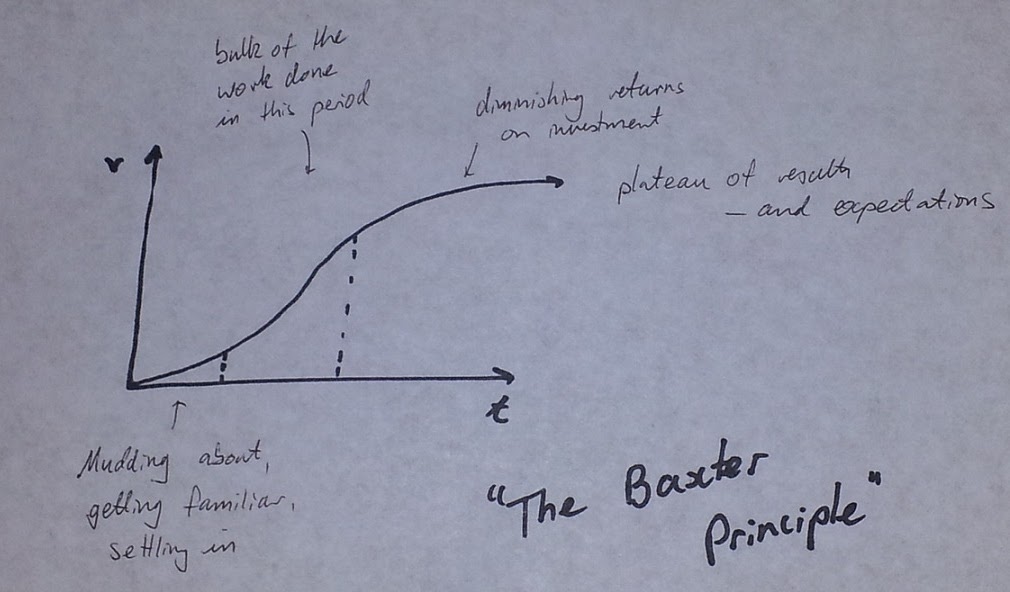
A law of diminishing returns applies to complicated work.  In fact, most work follows a sort of s-curve - we muddle around at the beginning trying to work out which way is up, get progressively more productive, but then find this rate eventually diminishes - and if we persist long enough will probably flatten out to being close enough to useless.  Perfectionism doesn't pay.  This pattern applies in a range of different contexts... Work on a task over the course of an hour, for example, and your brain will begin to tire, your work become less useful.  In defiance - or perhaps ignorance - of our own minds and bodies, our philosophy of work compels us to soldier on to our next designated break.  The same curve seems to apply to just about anything where you can plot work done against time, and where it's possible to continue working in relative isolation from significant change.


I'm learning to see how this curve is a result of the limits of my own individual experience and ability.  I might be planning planning a certain sort of event I'm not experienced with.  I could sketch something up, but knowing the limits of my experience, I will near the limits of my capacity very quickly.  I can spend a lot of time on it, perhaps make it marginally better, without getting much further than the first half hour's outline. What I can do, once I've realised I'm treading water, is raise it in discussion with a couple of others and get second and third opinions about what the event should look like.  Things are a bit messy as we all familiarise ourselves with what's going on and what's needed, but in relatively short time we have some great ideas.  We're all a little wiser, and we have together made a leap of progress on what I may have struggled on for hours.  I will probably go away and work on it myself, but I've had the limitations of my original thoughts disrupted and built up.  Sitting back down to start the work, I have a trajectory that will see me twice as better off, in a tenth of the time.


This phenomenon is reminiscent of the Pareto principle.  It reminds us that the productivity of our efforts is not even, and that we can achieve more by focusing on our most fruitful areas, rather than stressing over crumbs.  Pareto can be applied in lots of ways, but in this case it states that 80 percent of what you do comes from 20 percent of your time working on it. It might be a rough rule of thumb, but it's true enough to be worth applying - it's a consequence of distribution mathematics that apply in all sorts of unexpected situations. One thing to note with the principle is that you can't cheat it - you can't do a good bit of work, decide that's obviously your 80 percent for the day, and call it quits knowing you're not going to achieve much more.  There's a fair chance that some of your 'good 80 percent' will come amongst whatever you continue with that day.  In a general context, the one big thing I take away from the Pareto principle is that it doesn't pay to stress about small changes in inputs - in particular, your time and effort.  Not all inputs are equal, and you're much better off being relaxed, positive, and making sure you do good work than trying to squeeze in more work around the edges - focusing on doing good work keeps your exceptional 20 percent of inputs being put to good use.  Stressing about the time around the edges deteriorates your work overall, for the sake of squeezing out a few more unproductive moments.


You can't cheat the Pareto principle - but you can take advantage of it.  Returning to the 'value curves' described above - the 'good 80 percent' of value comes in the period in the middle of the curve, the steepest part.  When you've passed the point of diminishing returns, you can continue to work on that last 20 percent - or you can alter your approach, change the shape of the curve altogether, and increase your chances of finding an even greater '80 percent' than you were looking at before.


Yes, when you reset, you lose the trajectory that you were on - and if your ideal is to get near limit of the path you were on before, then this is probably an unsavoury and unnecessary risk.  If you have too little time available, then it just doesn't make sense to be spicing things up.  But if you do, you're dooming yourself to a substandard result - a lot of mediocrity is because we set our expectations too low, too early, based on the place we can see ourselves approaching.  Not based on the potential we have, if we open ourselves to other options.


In fact, I think with this post, I've past the point of diminishing returns.  I could rabbit on for hours, but whatever I say beyond this point will be getting more and more tedious... I need to give it up for now and come back to it when I get the chance to disrupt my trajectory.


The moral of the story is that when you're working on something, you will normally get to a stage where it's worthwhile changing your approach - whether that means a tea break, or phoning a friend.  Our philosophy of 'work' undermines our ability to make this call.  Not surprisingly, it is not easy learning to recognise our behaviour and act on it.


www.jsbaxter.com.au
@JohnSBaxter

Friday, September 21, 2012

A simple taxonomy for collaborative groups

What sorts of structures do collaborative groups come in?

I sat down this morning to write something about models for collaborative communities, and ended up writing a rather long post on communities, collectives and networks.  Or, more properly, on a few different stable group types I've noticed reappearing, that seem to form a set of 'archetypes' - as a result of group dynamics, and the different sorts of structures that can be stable.  The labels I've used make sense to me, but I haven't used them to be consistent with others - be warned!

This is an entry in my Collaborative Communities wiki - not currently online - which is the start of a project to create a book on Collaborative Communities, and how to work with them.


Group Taxonomy


Different group sizes, shapes, methods of interaction etc. support a range of different group types. There are a few particular, stable archetypes that many groups seem to approximate.

  • Communities
  • Collectives
  • Networks
These represent distinct - overlapping, fuzzy-edged - group types.

This is not an attempt to define or explain these terms - but rather an attempt to describe different group archetypes. Most people will probably disagree with this vocabulary!

In particular, 'communities' is normally used for any sort of group of any size that has internal connections and its own (emergent) behaviour, especially if that has a particular community 'feel'. It is also used to describe groups of greatly varying size based on geographical area (e.g. from a block to a district of a city with millions of people in it), or any group of people with a common identifier (irrespective of whether they are connected or identify with that group - for instance 'gamers'). In short, you can get away with calling any group a 'community'.

Communities

For the purposes of this project, communities are considerd to be groups, to which the members of which self-identify as 'belonging', with members connected to one another (primarily via first-order connections), and feel connected to one another, by virtue of being in this group.

Communities under this definition tend to be quite modest, by the standards and possibilities of modern connective capacity. (This is because they are constrained by Dunbar's Number, which is a limit on people's capacity to understand the set of human relationships in a group.) Depending on how permeable their edges are, these groups have a typical, maximum stable size at somewhere between 50 (for highly permeable groups, e.g. coworking communities) and 150 (for closed groups - e.g. villages or tribes).

A stable community can be supported in the most part by informal social norms and relationships. Few rules are needed, and policing and enforcement mechanisms are unecessary. Community maintenance roles can be largely informal.

Collectives

Once a group extends beyond this stable size, it will tend to either splinter and break into two, or it will require different supporting structures and take on different dynamics.

In the past, with limited connectivity tools, this usually meant bureaucratisation was necessary - the creation of a structured heirarchy, or some sort, with a centralised rule and enforcement framework. The cost of introducing these is high enough that a group will often go through an unstable 'danger' period as it leaps from being a stable community to a sustainable organisation.

Contemporary connection technology means different (more cost effective) mechanisms can be introduced to support the expansion of a group into taking on a new, flatter, leaner form, which we're calling a collective.

A collective has some sort of an underlying point of connection (which might be a purpose, or shared attribute between members), and a sense of membership based on this point of connection. Collectives foster relationships between members, but these need not be primarily first-order connections (i.e. it doesn't matter whether members know the other members), and while there may be a point of connection, there is less affinity between members.

The ability to efficiently and effectively connect with many more members than the Dunbar number does not give us the ability to 'cheat' this number - it just means we can have very large networks. In practice, we will not be able to hold in our minds the set of relationships between the people we are connected to, and the emergent group dynamics will therefore be different.

A (mature) collective will normally have unevenly distributed connection density - with a core that looks a lot like a community, attached to an extended network. (The reason this is not just a community and a network together is that there is no real boundary between the core and the rest of the network - all are part of the collective.)

There are no real bounds on how many members can be part of a collective. Some collectives might be more sustainable at certain numbers (due to economies of scale), for instance 200+, but group dynamics can be stable at virtually any size - with appropriate supports in place.

Collectives require additional supports that communities don't need - though unlike bureaucracies, they don't necessarily need to be centralised. These supports might include:

  • formalised rule systems, including enforcement mechanisms (covering things like social behaviour and collaboration)
  • advanced communication tools (beyond face-to-face contact and direct emailing)
  • formal decision making methods
Some of these things may be applied successfully in smaller communities, but are not normally needed for communities to function.

Networks

Networks are groups of people joined by interpersonal networks, but not necessarily held together by any shared agenda or rallying thread.

Everybody (not in isolation) is part of large networks, by virtue of their personal connections, and their connections, and their connections... however being able to utilise these connections to collaborate effectively is relatively new. Modern communications technologies make it possible for networked collaboration to exist in ways that simply weren't feasible before.

Our 'mass' engagement methods are symptomatic of past challenges of coordinating large numbers of people. These methods typically aggregate participants as a large number of individuals with limited capacity to interact. Mass media and democratic voting systems are good examples. Some platforms fostered emergent network behaviour better than others - economic markets, for instance.

Modern technology makes radically different collaboration possible. Wikipedia is the most obvious example - Wikipedia provided a platorm that enabled stygmergic collaborative between millions of individuals, in a radically efficient way, and in only a few years made bureaucratically-managed encyclopedias redundant.


www.jsbaxter.com.au
@JohnSBaxter